
Here's a rule change for the World Cup that will never, ever happen:
If a player goes to the ground due to what seems to be an injury and the official has to stop play to have him checked out, then that player has to leave the field. At this point, his team would hae the option of either subbing for him or playing man-down for five minutes.
This would end all of the flopping relatively quickly. Well, maybe not for Neymar. He might need longer to decondition himself from rolling around on the grass as if no human being has ever endured such excruciating agony several times per game. Seriously, it's embarrassing.
Also, the time needs to be kept on the scoreboard so everyone knows exactly when the half or the game ends, but you already knew that.
As dramatic as Belgium's win over Japan was, with a goal just before stoppage time ended, there's a really strong likelihood that it would have come after time would have expired had time been kept like it is everywhere else in every other sport in the world.
So those are two of TigerBlog's World Cup pet peeves. So is the short corner. TB has never seen one work.
For all of those, the thing he really hates about the World Cup is when a game is decided by penalty kicks. That's how both games Sunday ended, as Russia defeated Spain and Croatia defeated Denmark (TB figured that when it was 1-1 after three minutes that it was headed to PKs at the same score).
Yes, it's dramatic and exciting and all, but it's an awful way to decide a game. It's not that dissimilar from deciding a tied basketball game by a free throw shooting contest.
Actually it's worse than that. The biggest problem is that a team can play to get to PKs and then take its chances. You would have to play a much different game if you knew that no matter, you couldn't win without a goal.
And yes, every now and then you'd have a game that went on and on without a goal scored, but so what? That happens in the NHL playoffs too. If you wanted to avoid that problem, then take players off the field so it opens things up, like field hockey does.
Having a game go 120 minutes and then have it decided by PKs is hardly a fair way to determine which team advances in the World Cup and which one goes home.
It's like that in the NCAA soccer tournaments, which also decides the outcome by PKs if it's tied after the two overtime periods.
The Princeton women's team won its NCAA second-round game a year ago against N.C. State in penalty kicks. Had Princeton lost that game, it never would have had the opportunity to do what it did in the next round, which was defeat 21-time NCAA champion North Carolina (in OT, but not in PKs).
And even with that, TigerBlog still doesn't think it's the right way to decide a winner.
While the World Cup goes on in Russia, the Princeton men's lightweight team will be in England at the very prestigious Henley Royal Regatta. You can read more about it HERE.
It has to be great for American college athletes to compete in England on the Fourth of July.
Finally, TigerBlog needs to shift to a sadder note today and remember two people who passed away yesterday, both of whom had strong connections to Princeton men's basketball.
The first is Jim O'Connell, who was a national college basketball writer for the Associated Press and, TigerBlog is pretty sure, the uncle of former Tiger Sean Gregory. The other is Stan Adelson, a longtime Princeton fan and, TB believes, one-time head of the Friends of Princeton Basketball.
TigerBlog knew Stan a lot better than he knew the man whom he never heard anyone call by his name. Nope, Jim O'Connell was simply "Ock" to everyone.
TB spent a lot of time with Ock in the mid-to-late 1990s, during Princeton's run those years to Ivy titles, NCAA tournaments, national rankings and NITs. He'd seen him or heard from him every now and then, and each time it was like he was a long-lost relative checking in.
Ock died of a heart attack at the age of just 64. He was a big, friendly, funny man who had time for everyone. He was an ultimate people person, and he just loved to be in a media room at a basketball game.
If Ock was a welcoming man, then Stan Adelson could best be described as a gentle man, and a gentleman. His quiet, respectful persona sort of didn't match with his life as a Major in the Air Force, TigerBlog always thought.
Stan, who was a month away from his 95th birthday, was a grandfatherly man to everyone at Princeton basketball. He certainly was to TigerBlog, who knew Stan for 30 or so years.
TigerBlog is trying to think of anyone he's ever met who loved Princeton basketball more than Stan, and if there's anyone, it's a very short list.
Stan was a Jadwin Gym fixture for decades. He loved the players and the coaches and the game nights. He was a soft-spoken man, one who smiled all the time, hugged often, was polite to everyone and couldn't get enough of watching the Tigers.
They were very different people, Stan and Ock, with very different personalities. They were united by their love of basketball, and they have left lasting memories on a lot of people.
Included in that group is TigerBlog, who liked them both very much.
College basketball won't be quite the same without Ock.
Jadwin Gym won't be quite the same without Stan.
Tuesday, July 3, 2018


Monday, July 2, 2018
America's Top 40
If you're in TigerBlog's age range, then the words "America's Top 40" trigger not just the name Casey Kasem but also his unmistakable voice.
Each Saturday beginning in 1970, Casey Kasem would count down the top 40 songs of that particular week, and he would do so in his endlessly upbeat, happy style. If you go to the right station at the right time these days, you can hear an encore of a random week - and try to guess what songs might be in the top two or three as he gets close.
TigerBlog was always a big fan.
TB stumbled on a different version of "Americas Top 40" yesterday. It's a top 40 that goes like this:
* the SEC - 12 schools
* the Big Ten, Pac 12 and ACC - eight schools each
* the Big 12 - three schools
That's eight times three, plus 12 and three. That adds up to 39.
Princeton, then, was 40.
The final standings of the Learfield Directors' Cup were announced after the conclusion of the College World Series. Princeton came in 40th, making it the only non-Power Five conference school in this "America's Top 40."
TigerBlog will get back to that in a second. First, there's the College World Series.
TigerBlog has never been to a CWS, and he doubts he ever will go. He has of course been to a lot of lacrosse Final Fours, and he'll stick with those.
He did, however, watch more of this year's College World Series than he would have guessed he was going to when it started. If you watched it, then you saw the amazing end of Game 2 of the championship series between Oregon State and Arkansas.
TigerBlog likes the format, with two groups of four teams and then the two winners to decide the championship in a best-of-three playoff. One thing he loves about the lacrosse Final Four is that the weather isn't going to mess with it the way it can with the CWS, and that was the case this year, when rain pushed back Day 1 of the final.
Arkansas won Game 1 behind pitcher Blaine Knight, whose record is a fairly impressive 14-0. The Razorbacks, who have never won a national championship in baseball, then led 3-2 in the top of the ninth of Game 2, with two outs and a runner on third.
You probably saw what happened next. TigerBlog was watching. He'd watched most of the game, actually.
There was a pop-up near the stands on the first base side, and it looked all the world like Arkansas had won. Only the ball fell. And then there was a single to tie it. And then a home run to win it.
Arkansas wasn't just one strike away. It had the ball in the air with plenty of room to catch it and let it get away. It's one of the most excruciating near-misses that TB has ever seen.
The next night was all Oregon State. TigerBlog flipped between that game and the game between the Major League Lacrosse all-stars and the U.S. National team for the upcoming World Championships.
Sophomore Kevin Abel, who was incredible in the game and who retired the final 20 he faced, did a bunch of things that no Major League pitcher would ever be allowed to do these days in OSU's 5-0 win, including:
* throw a complete game
* throw 125 pitches
* pitch out of a bases-loaded jam in the third inning
Anyway, congratulations to Oregon State, and to TigerBlog's colleague in the marketing office, Macall Martin, who came to Princeton from Oregon State not that long ago.
Even with the baseball championship, Oregon State still finished 20 spots behind Princeton in the Directors' Cup. This was the 25th year of the competition, and Stanford won for the 24th straight time.
The Directors' Cup attempts to measure the best overall athletic program in the country by awarding points based on NCAA tournament participation and success. Princeton has been the highest finishing Ivy League school 22 times in 25 years.
Princeton has been in the top 50 22 times and has never finished below 63. The best finish the program had was 21st in the 2001-02 academic year, and the Tigers have had an average finish of 38.9.
It's a testament to Princeton's commitment to competitive excellence as an equal partner to it's other core mission, defined as Education Through Athletics.
It's wildly impressive to be able to compete with the schools that Princeton does in the Directors' Cup. Think about it. All of the schools in the top 40 with Princeton have gigantic athletic budgets and are at the forefront of the college athletics arms race.
For Princeton, it's a different path to the success, but one that gets there nonetheless.
This year, it has one again yielded a well-earned spot in America's Top 40.
Friday, June 29, 2018
A Few Minutes With Mollie
TigeBlog promised you a "first" today, and he'll get to that in a second.
First (before the actual first), there's something that he doesn't quite understand.
Readership numbers are way up. They're not usually up this time of year. Why is that?
Not that TigerBlog is complaining of course. The more the better.
It's like finding out that sales of exceeded your expectations. That's good, obviously. Is it worth wondering why, or just go with it?
Today will be a good test. It's an actual summer Friday, and summer Fridays are traditionally the absolutely lowest readership numbers TigerBlog gets. What does today hold?
In the past, knowing how few people were reading on summer Fridays, TB would sometimes insert random song lyrics in the middle to see if anyone noticed. Actually, that's not true at all.
He actually thought about testing that theory in college on an exam by writing song lyrics in the middle of a blue book to see if the professor noticed. He never did, deciding instead that there was too big a downside if he'd been wrong about that.
Anyway, he'll be eager to see how many people stop by today, and as the summer continues to go along.
Of course, this is a different kind of summer weekend. There's no Fourth of July weekend this year, since the holiday is smack in the middle of next week, so TB figures people will be improving with this weekend or next weekend or both.
In the meantime, TigerBlog promised you a first, and he will be delivering on that.
If you went to goprincetontigers.com yesterday, perhaps you saw the first episode of "A Few Minutes With Mollie."
If you didn't, you can see it HERE. It's the latest podcast from Princeton Athletics, and the first that involves Ford Family Director of Athletics Mollie Marcoux Samaan.
The podcast series here has been way more successful than TigerBlog envisioned when he first started doing them, and when his colleague Craig Sachson did it before he did. He's hoping to have a different podcast each day during the week come the fall, though those plans aren't finalized yet.
He definitely wanted to included Mollie in the series, though he's not sure she'll be able to do one each week. He wanted to do the first one with her now, though, and he's pretty happy with how it came out.
Mollie, of course, was an athlete here, an All-Ivy pick in both soccer and hockey. She came to Princeton from Ithaca, N.Y., and she had several other Ivy League opportunities coming out of high school.
Today she is the fifth AD Princeton has had. TigerBlog has known her since she was a student-worker in the Office of Athletic Communications, and he's worked for her for four years now. He's had a lot of conversations with her about a lot of things, but sitting down and asking her how her own experiences as an undergrad have shaped her beliefs as AD isn't something that just comes up in your average meeting.
The podcast gave him the opportunity to ask her about it. She talked about Bob Myslik, who was the AD when she was an athlete here, and Amy Campbell, who was in the athletic administration back then and who, as TB wrote recently, has just retired from the University, and TB asked her about the impact that had on her and if it's something she consciously wants to give to the current generation of athletes.
The best part about the podcasts is that they are so informal. TigerBlog has no script or set questions. He just lets it flow and see where the conversation goes.
As a result, they're very good ways to get to know the subject, in this case the AD. She talks about, in addition to what TB has already mentioned, the values of the department, the success Princeton has had, her interactions with the athletes here and her unwavering belief that Princeton Athletics, while it remains focused on competitive success and its core values, should never stop being fun.
TB isn't quite sure how many podcasts Mollie will be able to fit into her schedule, but he thinks this will become a regular feature. For now, Episode 1 is worth, well, a few minutes.
And with that, TigerBlog wishes everyone a great summer weekend.
Thursday, June 28, 2018
The Titus Shell
So, uh, yeah, TigerBlog was wrong.
TB said yesterday that he was confident Germany and Brazil would advance through the group stage at the World Cup, even though both faced elimination. He was wrong.
He didn't count on South Korea 2, Germany 0, coupled with Sweden 3, Mexico 0.
The results shockingly meant that Germany will not advance out of the group stage for the first time ever. It's also the third straight time and fourth time in the last five World Cups that the defending champion did not make it past the group stage.
Why is that?
What do you think of the way the TV broadcasts have been showing the standings for the groups in a way that assumes the point that particular game is at will stay that way. TB thinks it's great, though it took him a few times looking at it to get what they were doing.
The drama of final few minutes of the first games yesterday was extraordinary. Germany was scoreless with South Korea late into the game, and Mexico had suddenly fallen behind the Germans in goal differential, which is the first tiebreaker.
At that point, Germany needed a goal to knock out Mexico. TB just assumed it would come in the 91st minute or so, but instead it was South Korea who scored, just before stoppage time. The reaction of the Mexico fans at their game was amazing, since they were all clearly following the other game while it was all falling apart on the field for their team.
Now Germany needed to score twice to advance. Instead, they didn't score at all. South Korea would again, on a stunning empty net goal, something TB has never seen before. Germany, needing offense, had all 11 of its players across midfield, including the goalkeeper, and South Korea simply kicked it deep and then outran the Germans.
The crowd reactions that TigerBlog finds so annoying during American sporting events continue to be among the best parts of the World Cup. Maybe if U.S. fans cared as much - and TB isn't saying they don't care - as the international fans do, the reaction shots would be better. At the World Cup they're just so heartfelt, and they really help tell the story of the game.
And maybe it's because in soccer the momentum changes so many times, with a near-miss here and a counter there, but it seems like there are more emotional shifts to see.
Anyway, Brazil took care of things relatively easily to move on, but those 15 minutes or so that ended the Mexico-Sweden and Germany-South Korea games were extraordinary.
Meanwhile, back at TigerBlog's week of superlatives, he got an email from Greg Hughes, the heavyweight men's rowing coach, yesterday. If you've never met Greg Hughes, he's exact the kind of a coach you'd want your child to learn from, with an intense competitive spirit coupled with the perfect values to be a head coach at Princeton. He definitely buys into what Princeton Athletics wants to be.
Here's what he said to TigerBlog:
I saw your post on the first ever coaches at Princeton and wanted to pass this along. It is the brief history of Constance Titus, whom we recognize as the first “official” rowing coach. Prior to Titus, a grad student ran the program. Connie was also a remarkable oarsman in his own right and a big reason for his decision to coach at Princeton was the newly completed Carnegie Lake. He was the first person to row on the new lake… See the attached page from Rowing at Princeton with a brief history of Titus’s time at Princeton.
A cool side note: Just last summer, we took possession of the shell that Titus is rowing in this picture. It was built in 1898 and was the shell that he rowed to several championship victories. It was also the first ever hull to be rowed on Carnegie Lake. Later this summer, we hope to suspend it from the ceiling in the Ball Room at the boathouse along with some history on Titus.
Then he included this:
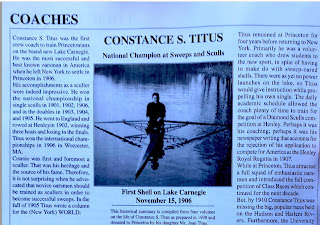 The part about the shell that Titus is using in the picture is fascinating. That'll be cool to see.
As for who the first actual head coach at Princeton, apparently that leaves it at either Langdon Lea in 1899 for football or Bill Clarke for baseball in 1900.
And that's enough superlatives for one week.
For tomorrow, TB has something different. A first, you might say.
Wait, that's a superlative, right?
TB said yesterday that he was confident Germany and Brazil would advance through the group stage at the World Cup, even though both faced elimination. He was wrong.
He didn't count on South Korea 2, Germany 0, coupled with Sweden 3, Mexico 0.
The results shockingly meant that Germany will not advance out of the group stage for the first time ever. It's also the third straight time and fourth time in the last five World Cups that the defending champion did not make it past the group stage.
Why is that?
What do you think of the way the TV broadcasts have been showing the standings for the groups in a way that assumes the point that particular game is at will stay that way. TB thinks it's great, though it took him a few times looking at it to get what they were doing.
The drama of final few minutes of the first games yesterday was extraordinary. Germany was scoreless with South Korea late into the game, and Mexico had suddenly fallen behind the Germans in goal differential, which is the first tiebreaker.
At that point, Germany needed a goal to knock out Mexico. TB just assumed it would come in the 91st minute or so, but instead it was South Korea who scored, just before stoppage time. The reaction of the Mexico fans at their game was amazing, since they were all clearly following the other game while it was all falling apart on the field for their team.
Now Germany needed to score twice to advance. Instead, they didn't score at all. South Korea would again, on a stunning empty net goal, something TB has never seen before. Germany, needing offense, had all 11 of its players across midfield, including the goalkeeper, and South Korea simply kicked it deep and then outran the Germans.
The crowd reactions that TigerBlog finds so annoying during American sporting events continue to be among the best parts of the World Cup. Maybe if U.S. fans cared as much - and TB isn't saying they don't care - as the international fans do, the reaction shots would be better. At the World Cup they're just so heartfelt, and they really help tell the story of the game.
And maybe it's because in soccer the momentum changes so many times, with a near-miss here and a counter there, but it seems like there are more emotional shifts to see.
Anyway, Brazil took care of things relatively easily to move on, but those 15 minutes or so that ended the Mexico-Sweden and Germany-South Korea games were extraordinary.
Meanwhile, back at TigerBlog's week of superlatives, he got an email from Greg Hughes, the heavyweight men's rowing coach, yesterday. If you've never met Greg Hughes, he's exact the kind of a coach you'd want your child to learn from, with an intense competitive spirit coupled with the perfect values to be a head coach at Princeton. He definitely buys into what Princeton Athletics wants to be.
Here's what he said to TigerBlog:
I saw your post on the first ever coaches at Princeton and wanted to pass this along. It is the brief history of Constance Titus, whom we recognize as the first “official” rowing coach. Prior to Titus, a grad student ran the program. Connie was also a remarkable oarsman in his own right and a big reason for his decision to coach at Princeton was the newly completed Carnegie Lake. He was the first person to row on the new lake… See the attached page from Rowing at Princeton with a brief history of Titus’s time at Princeton.
A cool side note: Just last summer, we took possession of the shell that Titus is rowing in this picture. It was built in 1898 and was the shell that he rowed to several championship victories. It was also the first ever hull to be rowed on Carnegie Lake. Later this summer, we hope to suspend it from the ceiling in the Ball Room at the boathouse along with some history on Titus.
Then he included this:

As for who the first actual head coach at Princeton, apparently that leaves it at either Langdon Lea in 1899 for football or Bill Clarke for baseball in 1900.
And that's enough superlatives for one week.
For tomorrow, TB has something different. A first, you might say.
Wait, that's a superlative, right?
Wednesday, June 27, 2018
The Greatest
TigerBlog was in an all-day meeting yesterday, which meant he missed what went on in the World Cup.
Apparently Diego Maradona had an interesting day. From what TB read, Maradona danced with and later gave the finger to Nigerian fans before collapsing and needing medical attention. Oh, and he fell asleep at one point?
If he slept or was out of it, then he missed a great game. For all of the issues that Argentina has had in this World Cup, it is through to the knockout round, courtesy of a late goal in a 2-1 win over Nigeria, a team that approximately 100 percent of the people who aren't Argentinian were rooting for, TB supposes.
TigerBlog read a story about Maradona, and it said something along the lines that he is considered by many to be the greatest soccer player of all time. TigerBlog remembers him as an all-time great, though he didn't realize that he was a co-winner of FIFA's Player of the Century award along with Pele.
To be called the greatest is obviously subjective. As TB wrote yesterday about all-time great Princeton coaches, there is no one right answer. No, you can't make a compelling case for too many, but "who is the greatest" is a staple of sports talk radio, among other venues.
TigerBlog would say that Michael Jordan is the greatest athlete he's ever seen. You can counter with a handful of people and make a strong case.
All of this brings TB to a question from loyal reader John Mack, who is not the greatest athlete TigerBlog has seen at Princeton, though he was a 10-time Heptagonal track and field champion and the 2000 winner of the Roper Trophy.
John's question was actually several months ago, but TigerBlog still hasn't come up with the right answer. What, John wanted to know, is the best team TigerBlog has ever seen at Princeton, in any sport.
Actually, TB thinks he actually asked what the best college team he ever saw was. Or maybe it was just Princeton. Either way, this one is a tough one.
Let's just keep it to Princeton.
Since TigerBlog has been around, Princeton has won 305 Ivy League championships and 37 national team championships. That's a lot of great teams to pick from, no?
Again, the problem is how you compare greatness in one sport to greatness in another? Does a team have to have won a national championship to be considered? There are many Princeton teams who could achieve great things and not come close to the national title, like the 2016-17 men's basketball team that went 16-0 in the Ivy League, including the first tournament.
Forgetting Princeton, if you extend it out to include any college sport, then it's possible that the greatest teams that TigerBlog has ever seen are the Trinity men's squash teams that were unbeatable for so long (like 13 straight national titles worth, before Princeton knocked off the Bantams for the 2012 championship, Bob Callahan's last as Tiger head coach). This requires considering simply how teams did within their sport, not how their sport figures into the national sporting conscience.
For that matter, the Princeton-Trinity national championship match in 2012, a 5-4 Princeton win to end that 13-year run, would be considered among the greatest sporting events of all time if squash was football or basketball. But hey, that's another question for another day.
In the meantime, there's more World Cup to be played. Today is a huge day, with four more games. By the end of the day, both Brazil and Germany can be knocked out before the knockout rounds, though much like Argentina, TB is pretty sure they'll both advance.
The group stage will end tomorrow. Then it'll be down to 16 teams.
This isn't like the NCAA basketball tournament, which TB thinks gets less exciting as it goes along. Still, the group stage is pretty special and has been great to watch.
And back at John Mack's question, TigerBlog can't even imagine where to start on this. He's been thinking about this one for months and still hasn't come up with his answer.
TB is going to have to give this one some more thought and make an actual list. Hey, he has all summer to do so.
It's a really good question though.
Anyone have any suggestions?
Tuesday, June 26, 2018
The Best ...
So yesterday TigerBlog tried to figure out who the first head coach in Princeton history was.
If you read it, then you know that TB couldn't really get an answer to that question. And if he couldn't answer that one, he definitely was going to come up empty for this one:
Who is the greatest coach in Princeton Athletic history?
The question of who was first is unanswerable because the records don't really clear it up. As TB said yesterday, there were two rowing coaches listed in the 1880s, but were they really coaches? And then if not, then was it the "unofficial" football coach in 1899, or the baseball coach in 1900?
The question of who is the best is unanswerable because anyone is entitled to an opinion and a case can be made for a lot of coaches throughout history here. Add to that the fact that there is no apples to apples comparison possible for a lot of those coaches, and really you can make a case for several.
It's not a huge list though.
As TB started to think about the greatest coaches in program history, he thought of the impossibility of comparing people like Betty Constable and Bill Roper. Constable coached the women's squash team from 1971 through 1991, going 117-16 and winning 12 Howe Cup national championships.
By the way, Betty Constable's maiden name was "Howe," and the trophy for the women's squash national championship is named for her family.
Roper was the football coach at Princeton for 17 seasons between 1906 and 1930. During that time he went 89-28-16 (no Princeton football coach has ever won more games) and 11 national championships.
How do you compare them?
For that matter, how do you compare Roper to Charlie Caldwell (70-30-3, a national title and a Heisman Trophy winner) with Dick Colman (75-33-0, four Ivy titles)? Comparing different eras within the same sport is hard enough without adding in the vast variety of the sports.
The point is that it's all subjective, and you can make a case for a few. In fact, there are two current Princeton head coaches - men's track and field coach Fred Samara and women's lacrosse coach Chris Sailer - who would have to be in the conversation for the top 10 coaches this school has ever seen.
What makes someone the greatest coach ever anyway? You have to have won, a lot, at the very highest levels. You have to have done something that nobody else in your sport has done. And you had to do it for a long time.
Where does that leave someone like former field hockey coach Kristen Holmes-Winn? Her record is extraordinary - 164-80 record with 12 Ivy titles in 14 years and the crowning jewel of her tenure. She also has something no other Ivy League field hockey coach has - an NCAA championship.
Ah, but is that long enough to be considered?
By the way, if you're looking for a rising star, there's Holmes-Winn's replacement Carla Tagliente, who in two years has an NCAA semifinal and quarterfinal appearance (Holmes-Winn's first Final Four was in her seventh year).
TigerBlog has a sense, though, that if he asked 100 knowledgeable Princeton fans who the greatest coach in Princeton history is, he'd get an pretty large majority of the votes for two people - Bill Tierney and Pete Carril.
You know their accomplishments. Carril in 29 years as the men's basketball coach won 514 games, 13 Ivy League titles and the 1975 NIT. He also took Princeton to 11 NCAA tournaments and had the great win over UCLA in the 1996 NCAA tournament, his last.
As for Tierney, he spent 22 years here and won six NCAA tournaments, went to eight NCAA finals and went to 10 Final Fours. He won 14 Ivy League championships. He did all this with a program that had never been to the NCAA tournament prior to his arrival.
Those are insane numbers.
Why go through all of this the last two days? It started last week, when Tierney was in town and stopped by. He also stopped in on someone who, if she wants to stay here long enough, will make a serious run at being up there with the best of them.
Her record after 11 years is 232-93. She's won six Ivy League championships and gone to seven NCAA tournaments (and two WNITs) for a program that had not been in the NCAA tournament prior to her arrival. She's also won an NCAA tournament game (just the second in league history) and got the league's first at-large bid for either men or women.
TB is talking about Courtney Banghart, of course.
And it was Courtney who texted this picture to TB late last week:
 The first coach in Princeton history? Unclear.
The greatest coach in Princeton history? Debatable.
The picture of Banghart and Tierney? Well, let TB add it together for you:
* 22 Ivy titles
* 34 NCAA tournaments (including Tierney's nine at Denver)
* 470-179 record at Princeton (interestingly, Banghart has coached 325 games at Princeton, while Tierney coached 324 here)
Hey, in this case, a picture was worth about 900 words.
If you read it, then you know that TB couldn't really get an answer to that question. And if he couldn't answer that one, he definitely was going to come up empty for this one:
Who is the greatest coach in Princeton Athletic history?
The question of who was first is unanswerable because the records don't really clear it up. As TB said yesterday, there were two rowing coaches listed in the 1880s, but were they really coaches? And then if not, then was it the "unofficial" football coach in 1899, or the baseball coach in 1900?
The question of who is the best is unanswerable because anyone is entitled to an opinion and a case can be made for a lot of coaches throughout history here. Add to that the fact that there is no apples to apples comparison possible for a lot of those coaches, and really you can make a case for several.
It's not a huge list though.
As TB started to think about the greatest coaches in program history, he thought of the impossibility of comparing people like Betty Constable and Bill Roper. Constable coached the women's squash team from 1971 through 1991, going 117-16 and winning 12 Howe Cup national championships.
By the way, Betty Constable's maiden name was "Howe," and the trophy for the women's squash national championship is named for her family.
Roper was the football coach at Princeton for 17 seasons between 1906 and 1930. During that time he went 89-28-16 (no Princeton football coach has ever won more games) and 11 national championships.
How do you compare them?
For that matter, how do you compare Roper to Charlie Caldwell (70-30-3, a national title and a Heisman Trophy winner) with Dick Colman (75-33-0, four Ivy titles)? Comparing different eras within the same sport is hard enough without adding in the vast variety of the sports.
The point is that it's all subjective, and you can make a case for a few. In fact, there are two current Princeton head coaches - men's track and field coach Fred Samara and women's lacrosse coach Chris Sailer - who would have to be in the conversation for the top 10 coaches this school has ever seen.
What makes someone the greatest coach ever anyway? You have to have won, a lot, at the very highest levels. You have to have done something that nobody else in your sport has done. And you had to do it for a long time.
Where does that leave someone like former field hockey coach Kristen Holmes-Winn? Her record is extraordinary - 164-80 record with 12 Ivy titles in 14 years and the crowning jewel of her tenure. She also has something no other Ivy League field hockey coach has - an NCAA championship.
Ah, but is that long enough to be considered?
By the way, if you're looking for a rising star, there's Holmes-Winn's replacement Carla Tagliente, who in two years has an NCAA semifinal and quarterfinal appearance (Holmes-Winn's first Final Four was in her seventh year).
TigerBlog has a sense, though, that if he asked 100 knowledgeable Princeton fans who the greatest coach in Princeton history is, he'd get an pretty large majority of the votes for two people - Bill Tierney and Pete Carril.
You know their accomplishments. Carril in 29 years as the men's basketball coach won 514 games, 13 Ivy League titles and the 1975 NIT. He also took Princeton to 11 NCAA tournaments and had the great win over UCLA in the 1996 NCAA tournament, his last.
As for Tierney, he spent 22 years here and won six NCAA tournaments, went to eight NCAA finals and went to 10 Final Fours. He won 14 Ivy League championships. He did all this with a program that had never been to the NCAA tournament prior to his arrival.
Those are insane numbers.
Why go through all of this the last two days? It started last week, when Tierney was in town and stopped by. He also stopped in on someone who, if she wants to stay here long enough, will make a serious run at being up there with the best of them.
Her record after 11 years is 232-93. She's won six Ivy League championships and gone to seven NCAA tournaments (and two WNITs) for a program that had not been in the NCAA tournament prior to her arrival. She's also won an NCAA tournament game (just the second in league history) and got the league's first at-large bid for either men or women.
TB is talking about Courtney Banghart, of course.
And it was Courtney who texted this picture to TB late last week:

The greatest coach in Princeton history? Debatable.
The picture of Banghart and Tierney? Well, let TB add it together for you:
* 22 Ivy titles
* 34 NCAA tournaments (including Tierney's nine at Denver)
* 470-179 record at Princeton (interestingly, Banghart has coached 325 games at Princeton, while Tierney coached 324 here)
Hey, in this case, a picture was worth about 900 words.
Monday, June 25, 2018
The First ...
TigerBlog starts today with what should be a simple question.
Who was the first head coach in Princeton history?
By the way, did you have a good weekend? Hopefully you did.
Anyway, back at the first head coach. This is the kind of historical stuff that TigerBlog loves, by the way.
The first Princeton athletic event was a baseball game against Williams in 1864. The first football game wasn't until five years later. Somebody must have coached those teams, right?
Well, according to the records, those teams were run by captains, not coaches. TigerBlog already knew that.
He also knew that sports like golf, rowing and lacrosse dated to the 1800s. He also knew that lacrosse dropped the program in the 1800s and didn't pick it up until 1921, and the first program coach wasn't listed until the program started again.
The golf program started in 1897, which is a little later than TB would have guessed before he looked it up. Maybe he thought that because Princeton won 12 national championships and thought they started earlier than 1914.
That left rowing, which dates to 1872. As with the other sports, the earliest teams were led not by coaches but by captains.
For some reason, Princeton dropped rowing in 1878. TB has no idea why, nor can he think of something plausible, since rowing was as big a sport as there was in this country then. In fact, TigerBlog has read somewhere that Andrew Carnegie built a lake and not a football stadium in Princeton because he thought rowing would become a bigger sport.
The rowing program resumed in 1879 - and with an actual head coach, someone named G.D. Parmley. This is a bit murky though, at least to TigerBlog. Was he actually a coach?
Princeton rowing between 1880 and 1884 would have two seasons with a coach and captain listed and three with just a captain. None of those names appears twice. Princeton then dropped rowing again, until 1911, when it came back with the first rowing coach to appear for more than one year.
His name was J. Duncan Spaeth, and he was the coach from 1911 through 1925 (except during World War I). It makes TB think that the two rowing coaches in the 1880s were more captains than actual coaches.
The first head football coach wasn't listed until 1901, when Langdon Lea led the Tigers to a 9-1-1 record. Lea is in the college football Hall of Fame after being an All-American tackle in 1893, 1894 and 1895.
He's not listed as the head coach in Princeton's records until, as TB said, 19091. He was, though, listed as an unofficial coach in 1899 and then the head coach at Michigan in 1900. He also never coached again after the 1901 season, though TigerBlog has no idea what he did after that, until his death in 1937.
TB did find this on Lea's Wikipedia page:
"Last year he took hold of the University of Michigan football team and instilled such a knowledge of the game into the green material he had to work on that he is today acknowledged to be one of the greatest coaches in the country. He could have renewed his contract, said to be worth $4,000. for next season, but sacrificed this sum to become head coach at Princeton, a position not worth nearly so much and one which involves harder work and greater responsibility. … Lea was appealed to and accepted the position. In his undergraduate days Lea was one of Old Nassau's stars. He was captain in 1895 and played the position of left tackle in such a manner as to gain a place on the All America team."
TB is relatively sure that Bob Surace laughed at that.
There would be another head coach in 1902, Garret Cochran, who also lasted one year and went 8-1. He had spent two years at Cal and one at Navy before coaching the Tigers, and he too never coached again.
Garret would later fight in World War I and die of pneumonia on a ship on the way back from Europe. That's what it says on his Wikipedia page at least. He also is a member of the college football Hall of Fame.
The men's hockey and men's basketball teams started in the 1900-01 seasons, but with a difference - men's basketball lists a coach, Mowbray Forney. He went 7-5 that year, his only one as coach.
The baseball team also had its first coach in the 1900 season. That would be Bill Clarke; perhaps you've seen a game at Clarke field at one time. Clarke, by the way, won 564 games in three different stints as Tiger head coach over a 45-year span.
So who does that make the first head coach?
Again, it's murky. Was it G.D. Parmley in 1880? Was it an unnamed and unknown golf coach in 1897?
Was it Langdon Lea's unofficial year in 1899? What made it unofficial? Was it Bill Clarke in 1900? It definitely wasn't Mowbray Forney, since he didn't coach until January of 1901.
Anyway, TigerBlog will tell you tomorrow why he was thinking about all this in the first place.
Friday, June 22, 2018
Cup Stuff
You know what must be a really hard sport to officiate?
Soccer. Especially at the World Cup. For everything that goes into putting together the World Cup, or major international and professional soccer in general, why in the world is there still only one referee on the field?
If TigerBlog ever found himself as a soccer ref, he'd miss pretty much every call, since he'd spend most of his time trying to stay out of the way of the ball. Even for the best refs, though, how in the world are they supposed to properly call one of these games, especially when every game can turn on the closest of calls?
First of all, things happen so fast that it's hard for one person to see it all. Second of all, there's TB's least favorite part of the World Cup - the constant flopping that goes on in every game. Players go down to the ground like in agony that suggests that they will never walk without a limp again, only to pop back up 10 seconds later.
What percentage of those players are even the slightest bit hurt?
Then there's offsides. The referee's assistant stays even with the offensive player closest to the goal, so that he is sort of in the same offside position as the player. Then, presumably, if he doesn't see a defender between himself and the goal when the ball is played, then he raises the flag.
The problem with that is how do you watch both at the same time, especially when trying to see whether the ball is played at a time when there is a defender keeping the player onsides can be next to impossible on video, let alone in real life. Maybe they have to rely on hearing the ball played while watching the positioning of the players?
The World Cup has used video well so far, with penalty kicks called or a goal disallowed without having the game crawl to a halt. That's what TB would suggest to the NFL or college or pro basketball - watch it once and if there's nothing obvious, the call stands.
One way to help the refs would be to make the time clear to everyone on the scoreboard. Stop it on goals. Stop it when the ref signals to stop it. When it gets to 0:00, the half or game is over.
Also, in how many games do you have a referee and two teams who all speak the same language? What are they saying to each other when the players all get in the refs face, wagging their fingers at him, if they don't speak the same language?
Despite those little flaws, TigerBlog continues to thoroughly enjoy the World Cup. Way more than Lionel Messi, TB supposes, though not as much as Cristiano Ronaldo. Or the Iceland fans.
One thing about having games on Fox in any sport is that the network loves to do cutaway shots to fans who are watching the stands, getting their reactions to the twists and turns of a game. Usually they are too much, but at the World Cup those shots are tremendous. There's just so much emotion to them, way more than at any other athletic event TB knows.
Oh, and TB heard about fans of several countries - specifically Japan and Senegal - who bring plastic bags with them to the games and then clean up all the trash in their sections, leaving the stadium cleaner than when they got there. That's pretty nice.
Anyway, there are nine more games between today and Sunday as the group stage rolls along. Keep in mind - the tiebreaker for the group stage is goal differential and then goals scored, not head-to-head. That means the late goals that Argentina allowed to Croatia in the 3-0 game could really come back to be haunting, since Argentina is now at minus-3 (with just one point) with one game left. Iceland could take a real step towards advancing should it beat Nigeria today.
The World Cup final is still three weeks away. The first Princeton sporting event of the 2018-19 academic year is nine weeks from today.
That's awhile. If you go back nine weeks, it takes you back to the last weekend of April, which is when Princeton's men's lacrosse season ended. That seems like a long time ago.
In reality, the new athletic year will be here soon. The countdown to kickoff clock shows that there are 85 days until the first Princeton football game of 2018, which also seems like a lot but will be here soon enough.
Now it's time for summer camps here. There were young fencers and young football players at Princeton yesterday, and young squash players and young basketball players earlier in the week.
For the most part, it's quiet around here though.
And it's the first full weekend of summer. Whatever you're doing, TigerBlog hopes it's a good one.
Thursday, June 21, 2018
The TRS 80
TigerBlog is coming to you live from his MacBook Pro, as he does every day.
As he's sure you probably do as well, he completely takes the capabilities of this machine for granted. Without a single cord connected to it, he can access information from anywhere, send his own content out to the world, write, edit, design, look at videos and pictures, pretty much anything.
Look at yesterday afternoon, for instance. Without ever plugging into anything, TigerBlog was able to get an email from the Canadian Lacrosse Association at 3:30 and by 3:50 have a story up on Princeton's athletics webpage and social media about how Zach Currier would be representing Canada in the upcoming World Championships.
By the way, if you're a Princeton fan, you can start now to consider whether or not to root for Currier or Tom Schreiber, another Princeton alum who will play for the U.S., in what pretty much is an inevitable championship game.
That's certainly a higher probability than Portugal-Spain in the World Cup final, but hey, there's a chance for that too.
Meanwhile, the MacBook is certainly a far cry from where TB started out. Heck, it's a far cry from his first computer here, which was a Mac with a tiny screen, next-to-no memory and no way to be used unless it was plugged in to the wall and the printer.
And TigerBlog thought that computer was an incredible machine.
TigerBlog went to college in the late stages of the typewriter era, and in fact he was ahead of the curve with his electric typewriter with built-in correct ribbon. That was cutting edge.
Can you imagine what it was like, being one of the few kids in your dorm who could hit backspace, strike over a mistake and make the correction without having to use a separate correct tape or white out? That was big time.
When TB first started in the newspaper business, there were word processors in the newsroom. And what did you have when you went on the road?
You had something that was an incredible jump in technology. You had something that changed the way the newspaper business worked.
You had the Radio Shack TRS 80.
TigerBlog had one. The first stories he ever wrote about games at Princeton were written on his TRS 80. He'll tell you more about it in a few minutes, but first, why bring this up today?
It's because of this tweet he saw the other day:
Kevin Gorman, whom TB has never met, is a columnist and radio host in Pittsburgh. TigerBlog, by the way, has had one of those sandwiches with the French fries on them that Pittsburgh is famous for, and he can vouch for the fact that it's really good.
Meanwhile, back at Gorman and the TRS 80, he also added this tweet:
TigerBlog's first season covering Princeton men's basketball was 1989-90. Kit Mueller was a junior. Princeton had almost beaten Georgetown the year before. Everywhere the Tigers went, everyone wanted to see how they had come so close against the Hoyas.
In fact, TigerBlog wrote a story comparing Princeton to the Harlem Globetrotters in terms of how much of an attraction the team was. And he probably wrote it on a TRS 80.
Gorman says it was commonly referred to as a "Trash 80," but TB never heard that term. And, he can also tell you that before he got his own model, he used to have to either drive back to the office to file stories or, worse, dictate them (usually over a pay phone no less) if he was nowhere near Central New Jersey for a game.
The second tweet shows the Radio Shack in action. TB doesn't remember all of the workings of how you'd write a story on it, but basically you'd set up a new document, write the story and then transmit it to the paper.
As he recalls, the "F" keys were important in that process.
To send the story, he'd have to connect to a telephone line. Almost always this involved a phone jack, but when he first started out, there were still places that had phones whose lines went directly into the wall, like they did when TB was a kid. There were no phone jacks back then; you'd have to call the phone company and it would come and install the phone.
For the places he'd go where there were no phone jacks, he'd need what was known as acoustic couplers. You'd use the Radio Shack to dial out and, when you heard the "beep" that let you know you were connected, you'd have to take the phone and put it into this thing that looked like two suction cups.
Whether you sent it through the acoustic couplers or the phone jack, TB does remember that one of the "F" keys would light up while the story sent. Then, after a few minutes - yes minutes - that light would disappear, and presumably the story would be back at the newspaper.
Of course, you'd have to call and confirm, and about a fifth of the time there was some error in transmission, one that left the text at the paper just a bunch of seemingly random characters, requiring a resend.
And yes. The TRS 80 was a single-engine prop plane. The MacBook is the space shuttle.
Still, as Gorman's tweet suggests, there was something really, really special about the TRS 80.
Between games at Princeton, Rider, Trenton State College (now the College of New Jersey), Rutgers and Mercer County College, TigerBlog wrote hundreds of stories through the years on the TRS 80.
Part of a world that's gone, it was small and portable and for the most part reliable, and it was part of a great time to be part of the newspaper business.
As he's sure you probably do as well, he completely takes the capabilities of this machine for granted. Without a single cord connected to it, he can access information from anywhere, send his own content out to the world, write, edit, design, look at videos and pictures, pretty much anything.
Look at yesterday afternoon, for instance. Without ever plugging into anything, TigerBlog was able to get an email from the Canadian Lacrosse Association at 3:30 and by 3:50 have a story up on Princeton's athletics webpage and social media about how Zach Currier would be representing Canada in the upcoming World Championships.
By the way, if you're a Princeton fan, you can start now to consider whether or not to root for Currier or Tom Schreiber, another Princeton alum who will play for the U.S., in what pretty much is an inevitable championship game.
That's certainly a higher probability than Portugal-Spain in the World Cup final, but hey, there's a chance for that too.
Meanwhile, the MacBook is certainly a far cry from where TB started out. Heck, it's a far cry from his first computer here, which was a Mac with a tiny screen, next-to-no memory and no way to be used unless it was plugged in to the wall and the printer.
And TigerBlog thought that computer was an incredible machine.
TigerBlog went to college in the late stages of the typewriter era, and in fact he was ahead of the curve with his electric typewriter with built-in correct ribbon. That was cutting edge.
Can you imagine what it was like, being one of the few kids in your dorm who could hit backspace, strike over a mistake and make the correction without having to use a separate correct tape or white out? That was big time.
When TB first started in the newspaper business, there were word processors in the newsroom. And what did you have when you went on the road?
You had something that was an incredible jump in technology. You had something that changed the way the newspaper business worked.
You had the Radio Shack TRS 80.
TigerBlog had one. The first stories he ever wrote about games at Princeton were written on his TRS 80. He'll tell you more about it in a few minutes, but first, why bring this up today?
It's because of this tweet he saw the other day:
That's a Radio Shack TRS 80, friends. Doesn't it look great?Just found this relic from start of my newspaper career: Radio Shack TRS-80 (aka Trash-80). Ran on four AA batteries. RT if you used one: pic.twitter.com/gcqiQItdmV— Kevin Gorman (@KGorman_Trib) June 18, 2018
Kevin Gorman, whom TB has never met, is a columnist and radio host in Pittsburgh. TigerBlog, by the way, has had one of those sandwiches with the French fries on them that Pittsburgh is famous for, and he can vouch for the fact that it's really good.
Meanwhile, back at Gorman and the TRS 80, he also added this tweet:
Stop. TB is going to get weepy.— Kevin Gorman (@KGorman_Trib) June 19, 2018
TigerBlog's first season covering Princeton men's basketball was 1989-90. Kit Mueller was a junior. Princeton had almost beaten Georgetown the year before. Everywhere the Tigers went, everyone wanted to see how they had come so close against the Hoyas.
In fact, TigerBlog wrote a story comparing Princeton to the Harlem Globetrotters in terms of how much of an attraction the team was. And he probably wrote it on a TRS 80.
Gorman says it was commonly referred to as a "Trash 80," but TB never heard that term. And, he can also tell you that before he got his own model, he used to have to either drive back to the office to file stories or, worse, dictate them (usually over a pay phone no less) if he was nowhere near Central New Jersey for a game.
The second tweet shows the Radio Shack in action. TB doesn't remember all of the workings of how you'd write a story on it, but basically you'd set up a new document, write the story and then transmit it to the paper.
As he recalls, the "F" keys were important in that process.
To send the story, he'd have to connect to a telephone line. Almost always this involved a phone jack, but when he first started out, there were still places that had phones whose lines went directly into the wall, like they did when TB was a kid. There were no phone jacks back then; you'd have to call the phone company and it would come and install the phone.
For the places he'd go where there were no phone jacks, he'd need what was known as acoustic couplers. You'd use the Radio Shack to dial out and, when you heard the "beep" that let you know you were connected, you'd have to take the phone and put it into this thing that looked like two suction cups.
Whether you sent it through the acoustic couplers or the phone jack, TB does remember that one of the "F" keys would light up while the story sent. Then, after a few minutes - yes minutes - that light would disappear, and presumably the story would be back at the newspaper.
Of course, you'd have to call and confirm, and about a fifth of the time there was some error in transmission, one that left the text at the paper just a bunch of seemingly random characters, requiring a resend.
And yes. The TRS 80 was a single-engine prop plane. The MacBook is the space shuttle.
Still, as Gorman's tweet suggests, there was something really, really special about the TRS 80.
Between games at Princeton, Rider, Trenton State College (now the College of New Jersey), Rutgers and Mercer County College, TigerBlog wrote hundreds of stories through the years on the TRS 80.
Part of a world that's gone, it was small and portable and for the most part reliable, and it was part of a great time to be part of the newspaper business.
Wednesday, June 20, 2018
Don't Miss It Daisy
So what to write about on this warm Wednesday?
TigerBlog will start with "The Great Gatsby," and specifically this quote from Daisy:
“Do you ever wait for the longest day of the year and then miss it? I always wait for the longest day of the year and then miss it!”
Ah, that Daisy. She had so little to actually do in her life.
Back in Mr. Ridley's American Literature class sophomore year of high school, that quote sparked considerable discussion about the characters and themes of the book. Also back in Mr. Ridley's class, there was the incident surrounding "The Catcher In The Rye,"
TigerBlog told you this story before. Perhaps you remember it, from Feb. 1, 2010:
There is one part of the book where our protagonist, Holden Caufield, is just starting to feel good about life when he walks outside the museum and sees a profanity (the big one) scribbled on the side of the building. For Holden, this led back to total disillusionment. It's one of the most important passages in the book.
When Mr. Ridley called on one of TB's friends to read this part, he told him to read the obsenity as "the profanity." TB remembers thinking that Mr. Ridley meant to read it as it was written and not censor it, but what he actually meant was to substitute the actual profanity with the words "the profanity." Unfortunately for TB's friend, he thought the same as TB.
So yeah, there was a f-bomb, rolling all over a high school English class. In the 1970s. To this day, all these decades later, TB is positive he would have read it as the curse itself had he been the one called on.
Meanwhile, back at Daisy, the longest day of the year is either today or tomorrow. Either way, it'll be light out until after 9.
And it'll actually be summer, which starts tomorrow at 6:07 AM. Why 6:07? Who figured that out? Why not 5:38 or 6:25?
Anyway, the temperature the last few days has been near 100, with fairly high humidity, which is a proper ending to this spring.
If you define a nice spring day as temps between 62-72 with sunshine and no humidity, then maybe there were, what, five of those around here this spring? There were way more days either below 50 or over 80 or rainy than there there were nice ones in the last three months around here, or at least it seems that way.
Little by little, it'll get dark out earlier and earlier, all the way til when the clocks "fall back" on Nov. 4.
The time change will come a few hours after Princeton's eighth football game of the 2018 season, by the way. The Tigers will play Dartmouth in Week 8 this year, which marks a radical change for the Tigers.
Princeton and Dartmouth have played in each other in the final game of the season every year since 1990. You think that was a long time ago?
From 1976 through 1990, Princeton would open its season at Cornell and finish it home against Dartmouth one year and then the next open at Dartmouth and finish home against Cornell.
For a long time before that, Princeton would open with Rutgers and open its Ivy season with Columbia but would still play either Cornell or Dartmouth on the road early in the season and then finish at home against other, switching the next year. Penn would do the same to keep the league schedule balanced.
Presumably the reason was weather and the fear of playing a game in the snow and cold of mid-November in Ithaca and Hanover. That's what TB has always figured anyway. Why else would the schedule have worked that way?
Anyway, you know how far you have to go back to find a year when Princeton finished the season against a team other than Cornell or Dartmouth? All the way back to Yale, in 1945.
If you go all the way back to 1876, Princeton ended its season against Yale every year from that point through 1945 with only a handful of exceptions.
There was 1917 and 1918, the two World War I seasons during which Princeton played four total games, none against college teams. There was also 10 times in the 1930s and 1940s where Princeton ended the season against either Dartmouth, Army or Navy.
And there was one other exception. It was back in 1885, when the season ended against Penn. Now, 133 years later, Princeton will, for the second time ever, end the season against Penn.
Would the Tigers sign up now for a repeat of the way that year went? Well, Princeton went 9-0 that year, finishing the year with a 57-0 victory over the Quakers.
Princeton actually played Penn three times that year, winning all three by a combined 213-20. TigerBlog will go out on a limb and say Princeton will not beat Penn 57-0 this year.
He'll also go out on a limb and say that there's a better chance that somewhere this year in college football there will be a 57-0 game than there is that there be a game with the score of Princeton's win over Yale in 1885. That one was 6-5 Tigers.
Anyway, all that is weeks away now.
First up is summer, which starts tomorrow. And it'll also be the longest day of the year.
Don't miss it this time, Daisy.
Subscribe to:
Posts (Atom)

 Posts

